Artificial Intelligence is no longer something businesses are only experimenting with. Companies are already using AI in Business to automate routine work, understand customers, analyze information, and improve everyday decision-making. From small businesses to large organizations, AI is becoming part of how modern work.
At Learner Space Pro, we h teams elp learners understand these changes by connecting AI concepts with practical workplace applications. You do not always need to be an AI developer to benefit from understanding how the technology is being used.
How Are Businesses Using AI?
AI can be used for many different tasks, depending on the industry and the needs of the organization. Some common examples include:
- Automating repetitive tasks
- Analyzing large amounts of data
- Improving customer service
- Creating and managing content
- Detecting unusual activity
- Supporting business decisions
- Personalizing customer experiences
The important point is that AI does not always replace an entire job or process. In many cases, it helps people complete their existing work faster or more efficiently.
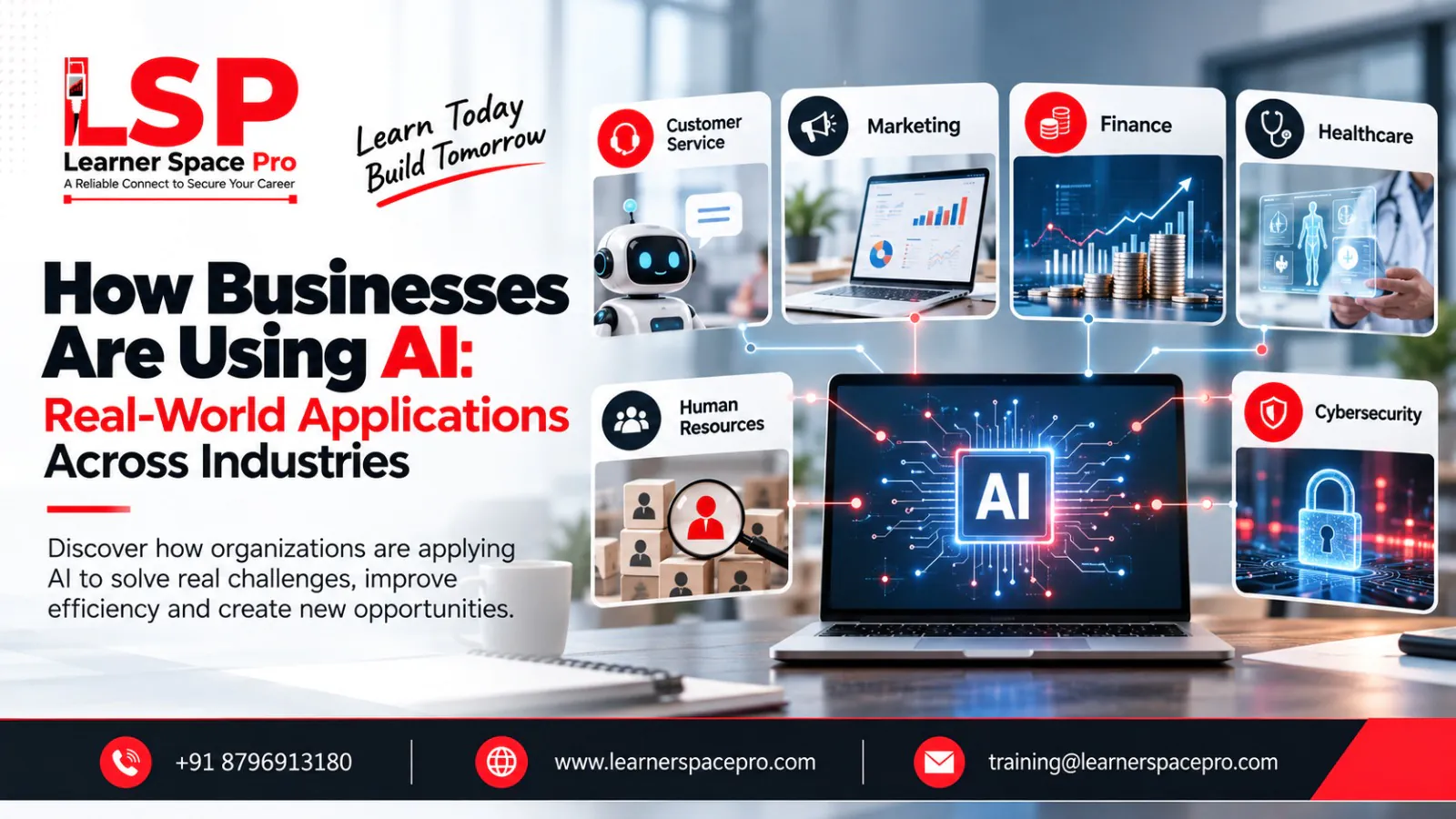
AI in Customer Service
Customer service is one area where AI is already making a noticeable difference.
Businesses can use AI-powered chatbots and virtual assistants to answer common questions, provide basic information, and help customers outside normal working hours.
For example, a customer may want to know the status of an order. Instead of waiting for an employee, an AI assistant can provide the information immediately.
Employees can then focus on more complicated customer problems that require human judgment.
AI in Marketing
Marketing teams are also using AI in many ways.
AI Tools can help professionals:
- Generate content ideas
- Analyze customer behaviour
- Personalize campaigns
- Research audiences
- Create marketing drafts
- Identify trends
This does not mean marketers can simply hand everything over to AI. Human creativity and judgment are still important, especially when it comes to understanding a brand and its audience.
AI in Finance
Financial organizations deal with huge amounts of information every day. AI can help analyse transactions, identify unusual patterns, support fraud detection, and assist with Financial Forecasting. For example, an AI system can examine transaction behaviour and flag activity that looks different from a customer’s normal pattern.
This allows financial teams to investigate potential problems more quickly.
AI in Healthcare
Healthcare is another area where AI is being explored and adopted. AI can help with areas such as medical research, analyzing images, managing information, and supporting administrative tasks.
The technology can help healthcare professionals work with large amounts of information, but important decisions still require qualified human professionals.
AI in Human Resources
HR teams can also use AI to make some routine processes easier.
AI tools can help organize information, create job descriptions, summarize documents, and support employee-related workflows.
However, organizations need to be careful when using AI for hiring or employee decisions. Human oversight is important because AI systems can produce biased or incorrect results if they are not designed and monitored properly.
AI in Cybersecurity
Cybersecurity teams deal with large amounts of security data and constantly changing threats.
AI can help identify unusual activity, analyze patterns, prioritize alerts, and support threat detection.
For security professionals, AI can act as an additional layer of support rather than a complete replacement for human expertise.
Does Every Business Need AI?
Not necessarily.
AI should solve a real problem rather than being introduced simply because it is popular.
Before adopting an AI solution, businesses should consider:
- What problem are we trying to solve?
- Will AI actually save time or money?
- What data will the system need?
- How accurate are the results?
- Who will review the output?
- What privacy and security risks are involved?
A simple AI solution that solves a genuine business problem can be more valuable than a complicated system that nobody knows how to use effectively.
What Skills Do Professionals Need?
As businesses adopt more AI tools, employees do not necessarily need to become AI engineers.
However, professionals can benefit from understanding basic AI concepts, knowing how to use AI tools, checking AI-generated information, and understanding when human judgment is required.
These skills can help employees work more effectively alongside AI.
Learn Practical AI Skills with Learner Space Pro
Understanding AI in Business is becoming useful for professionals across many industries. Whether you are working in marketing, finance, HR, IT, operations, or another field, knowing how AI can support everyday tasks can help you prepare for changes in the workplace.
At Learner Space Pro, our AI programs focus on practical learning and real-world applications, helping learners understand not just what AI is, but how it can be used effectively. Building these skills today can help you stay prepared as businesses continue to adopt AI.