Artificial Intelligence can be exciting when you first start exploring it, but it can also become confusing very quickly. There are hundreds of tools, courses, tutorials, and technologies to explore. Without a clear approach, beginners can easily make mistakes that slow down their progress. A simple AI Learning strategy can help you avoid these problems and build useful skills more confidently.
At Learner Space Pro, we believe that learning AI should be practical and structured. Instead of trying to understand everything at once, learners can start with the basics, practice regularly, and gradually move toward more advanced topics.
1. Trying to Learn Everything at Once
AI includes many different areas, including Machine Learning, Deep Learning, Generative AI, computer vision, natural language processing, and robotics.
Trying to study all of them at the same time can quickly become overwhelming.
Start with the fundamentals and explore different areas before choosing a specialization.
2. Focusing Only on Theory
Watching videos and reading articles can help you understand concepts, but theory alone will not build practical confidence.
After learning a concept, try to use it.
For example, after learning about Generative AI, experiment with an AI tool and see how different instructions affect the results.
3. AI Learning Tools Instead of Concepts
AI tools change quickly.
A tool that is popular today may be replaced by something better tomorrow.
Instead of memorizing how one particular tool works, understand the concepts behind AI and learn how to adapt to new tools.
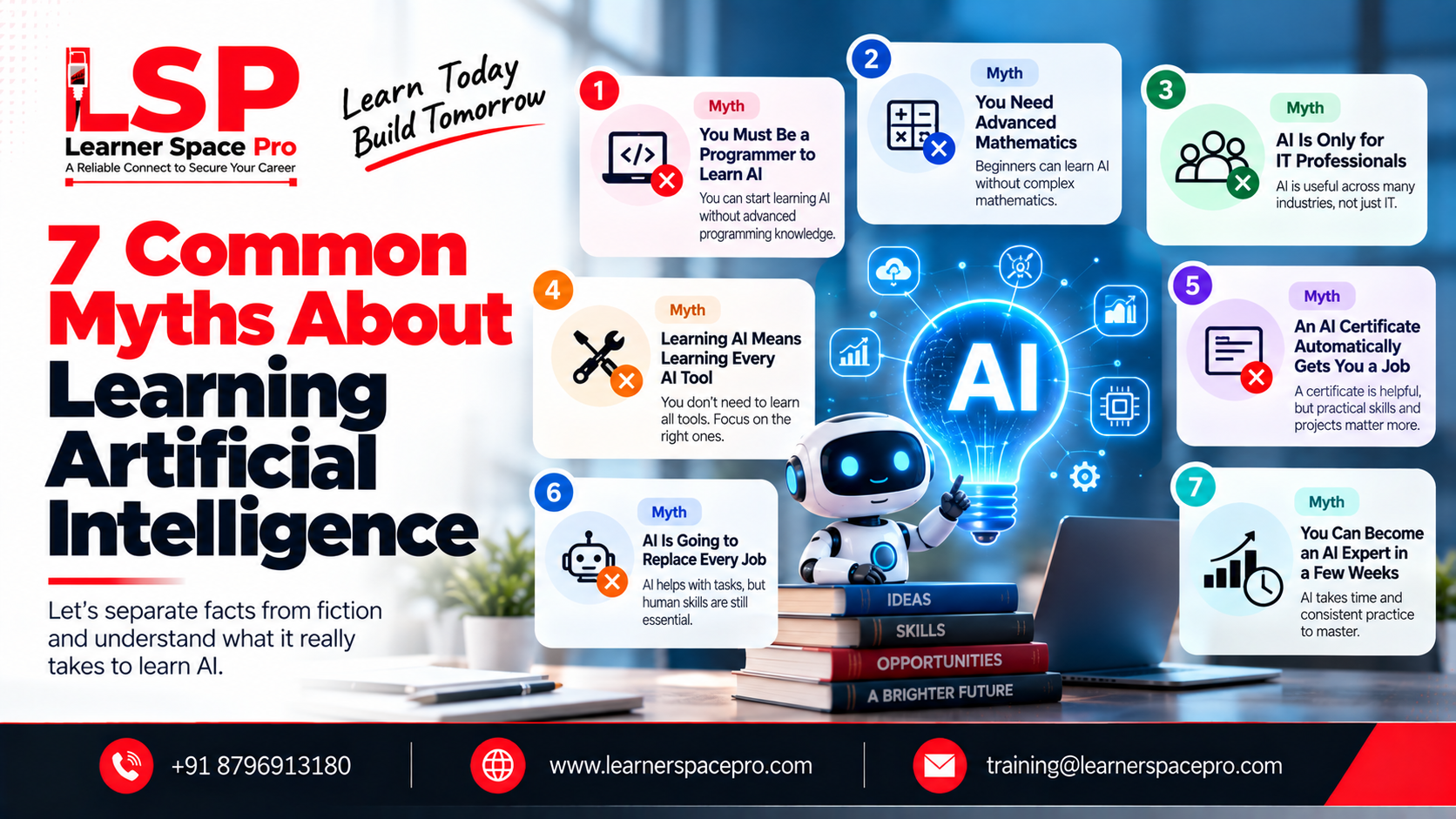
4. Thinking You Need Advanced Coding Immediately
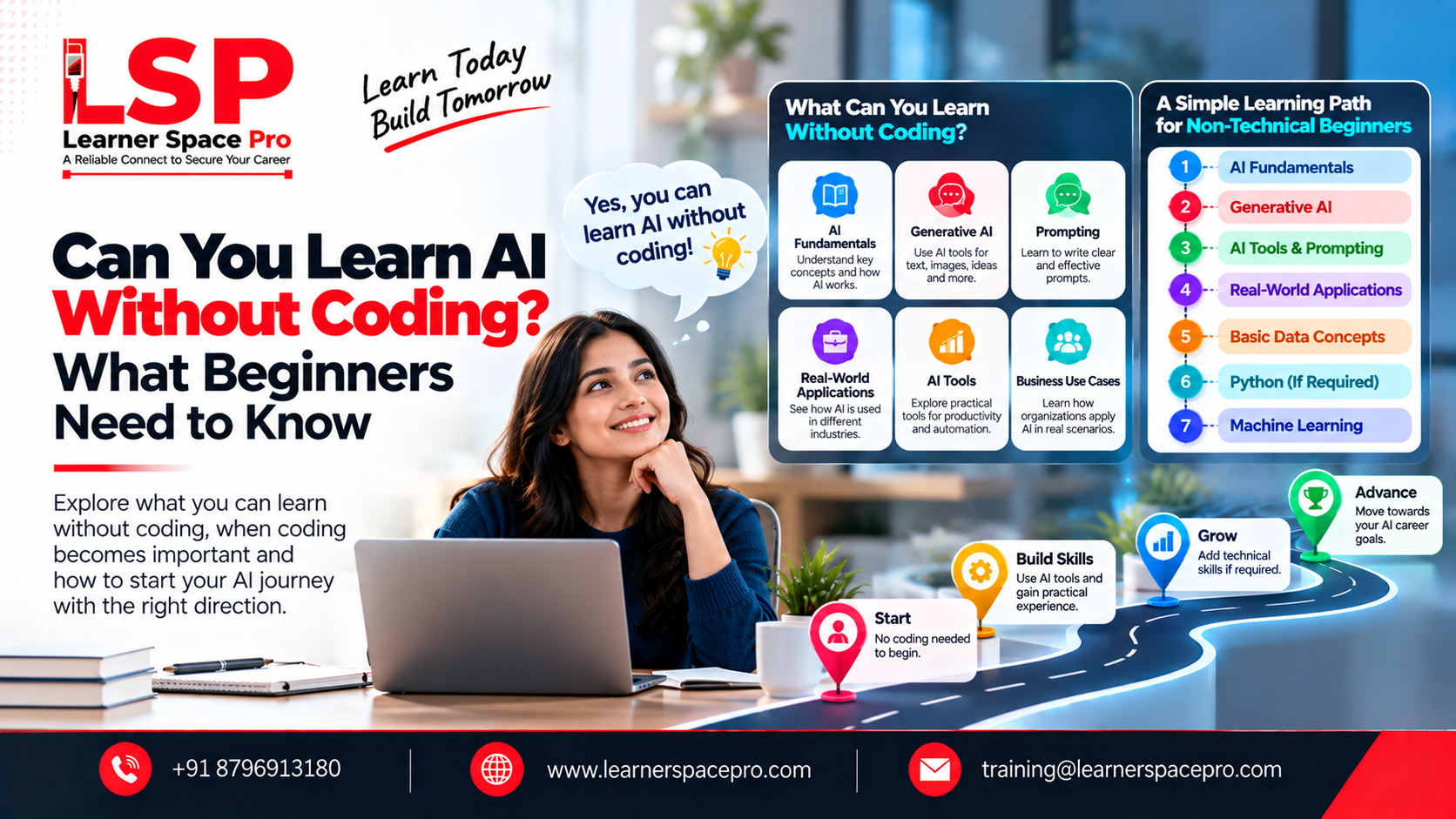
Programming is important for many technical AI careers, but beginners do not always need to start there.
If your goal is to understand AI or use AI tools at work, you can begin with fundamentals, Generative AI, prompting, and practical applications.
If you later decide to pursue a technical role, you can add Python and other programming skills.
5. Ignoring Data
AI systems depend heavily on data.
Beginners sometimes focus entirely on AI models without understanding where the data comes from or how its quality affects the results.
Learning basic data concepts can give you a much stronger foundation.
6. Trusting Every AI Answer
AI can produce convincing answers that are incorrect.
This is why you should not automatically accept everything an AI system generates.
Check important information against reliable sources, especially when dealing with financial, legal, technical, or business decisions.
Learning to evaluate AI output is an important part of becoming an effective AI user.
7. Copying Projects Without Understanding Them
Building projects is a great way to learn, but simply copying someone else’s code or project does not necessarily build your skills.
When you complete a project, try to understand:
- Why each component is being used.
- What the input is
- How the system processes information
- What the output means
- What could go wrong?
Understanding the process is more valuable than simply having a finished project.
8. Choosing a Course Only Because of the Certificate
A certificate can be useful, but it should not be the only reason you choose a course.
Before enrolling, look at the curriculum, practical exercises, trainer experience, learning support, and real-world applications.
The knowledge you gain should be more important than the certificate itself.
9. Not Practicing Regularly
AI skills develop through practice.
You do not need to study for several hours every day.
Even a short, consistent learning routine can help. Try solving small problems with AI tools or working on simple projects several times a week.
Consistency is usually more useful than studying intensely for a few days and then stopping.
10. Not Having a Clear Goal
Perhaps the biggest mistake is learning AI without knowing why.
Ask yourself:
What do I want AI to help me achieve?
You might want to:
- Improve your current job.
- Learn AI tools.
- Move into a technical career.
- Start working with data.
- Build AI applications.
- Explore Generative AI
- Add AI skills to your existing profession.
Your answer should influence what you learn next.
A Better Way to Approach AI Learning
A simple approach can make the process much easier:
Understand the Basics → Practice With AI Tools → Learn Data Concepts → Develop Technical Skills if Needed → Build Projects → Choose a Specialization
You do not have to follow this path perfectly. The important thing is to have a direction and consistently apply what you are learning.
Build Better AI Skills with Learner Space Pro
Good AI Learning is not about completing the largest number of tutorials or memorizing every AI tool available. It is about understanding useful concepts, practicing them, and knowing how to apply them to real problems.
At Learner Space Pro, our AI programs are designed to help learners develop practical knowledge through structured learning and real-world examples. Whether you are a complete beginner or already exploring AI tools, a focused learning approach can help you make steady progress and build skills that remain useful as the technology continues to evolve.