If you have started preparing for Networking Fundamentals, you have probably come across the OSI Model. For many beginners, it seems like a diagram that needs to be memorized for the exam. In reality, the OSI (Open Systems Interconnection) Model is much more than that; it is a framework that helps explain how devices communicate across a network.
Understanding the OSI Model is essential because it forms the foundation of networking concepts such as routing, switching, troubleshooting, security, and data communication. At Learner Space Pro, we encourage learners to understand how each layer works instead of simply memorizing the seven layers. OSI Model Explained: A Beginner’s Guide makes it easier to solve Networking Problems and apply concepts in real-world environments.
What Is the OSI Model?
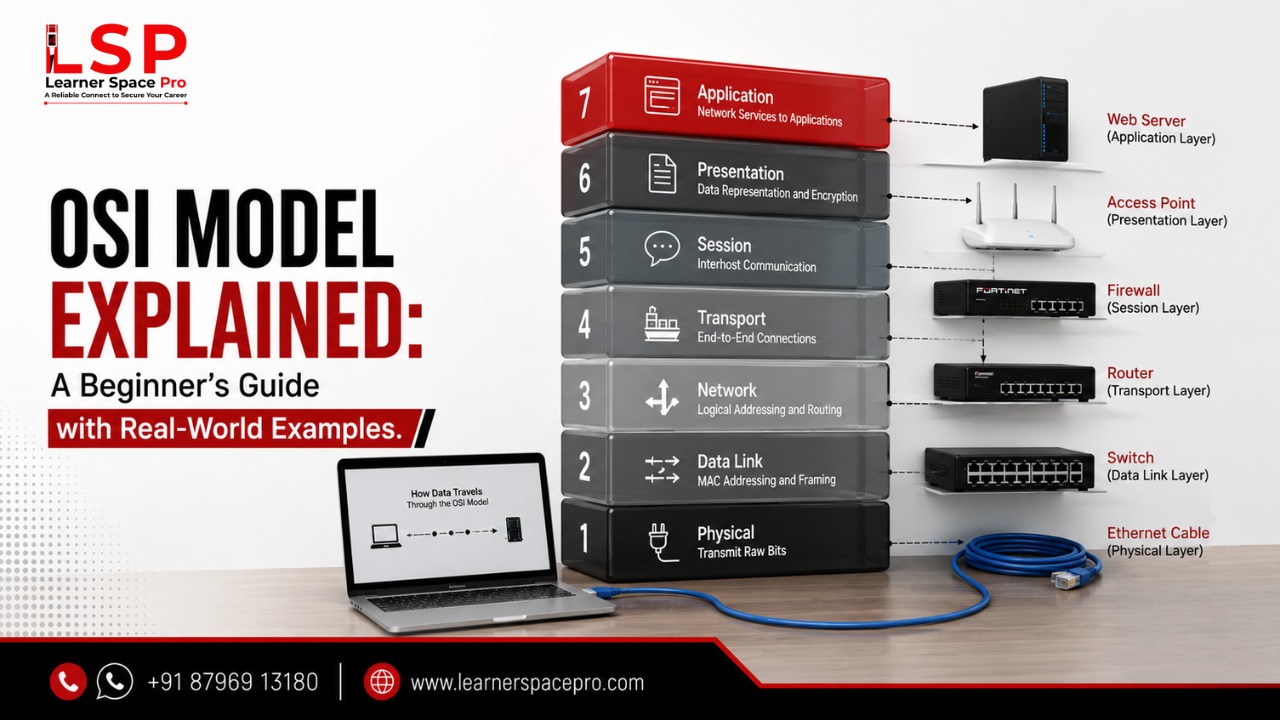
The OSI Model is a seven-layer framework developed to standardize how information travels between devices on a network. Each layer has a specific responsibility, and together they ensure that data is transmitted accurately and efficiently.
Think of it as a delivery system. Just as a package moves through packaging, transportation, sorting, and delivery before reaching its destination, data also passes through multiple stages before arriving at another device.
The Seven Layers of the OSI Model
Layer 1 – Physical
The Physical Layer includes cables, connectors, wireless signals, and network hardware that physically transmit data.
Without this layer, communication would not be possible.
Layer 2 – Data Link
This layer manages communication between devices on the same local network.
Switches primarily operate at this layer using MAC addresses to forward data efficiently.
Layer 3 – Network
The Network Layer is responsible for routing data between different networks.
Routers operate at this layer by determining the best path for packets to travel.
Layer 4 – Transport
The Transport Layer ensures that data is delivered accurately and in the correct order.
Two commonly used protocols are:
- TCP (Reliable communication)
- UDP (Faster communication)
Layer 5 – Session
This layer establishes, manages, and terminates communication sessions between devices.
Whenever you join an online meeting or log into a website, the Session Layer helps maintain that connection.
Layer 6 – Presentation
The Presentation Layer translates, encrypts, and compresses data before it reaches the application.
For example, HTTPS encryption takes place at this stage to protect sensitive information.
Layer 7 – Application
This is the layer users interact with directly. Applications such as web browsers, email clients, and video conferencing software communicate with the network through this layer.
Examples: HTTP, HTTPS, FTP, SMTP
Why Is the OSI Model Important?
Understanding the OSI Model makes networking much easier because every networking problem can usually be traced to one or more layers.
For example:
- No internet connection? Check the Physical Layer.
- Wrong IP address? Investigate the Network Layer.
- Website not loading correctly? Examine the Application Layer.
- Network engineers around the world widely use this structured troubleshooting approach.
How CCNA Students Benefit from Learning the OSI Model?
The networking fundamentals covers routing, switching, network security, wireless networking, and troubleshooting, all of which rely on understanding the OSI Model.
Instead of treating it as a theory topic, think of the OSI Model as a roadmap that explains how every network functions. Once you understand the role of each layer, learning advanced networking concepts becomes much easier.
For learners looking to strengthen their practical networking knowledge, enrolling in a structured CCNA Training in Chennai program provides guided lab exercises and instructor-led sessions that connect theoretical concepts with real-world applications.
Build Strong Networking Fundamentals with Learner Space Pro
Every successful networking professional begins by mastering the fundamentals. The OSI Model is one of the first concepts you will encounter and understanding it will make every other networking topic easier to learn.
At Learner Space Pro, our practical training approach helps learners prepare for networking fundamentals through hands-on labs, real-world networking scenarios, and expert guidance. By focusing on concepts instead of memorization, we help learners develop the confidence and technical skills needed for a successful networking career.