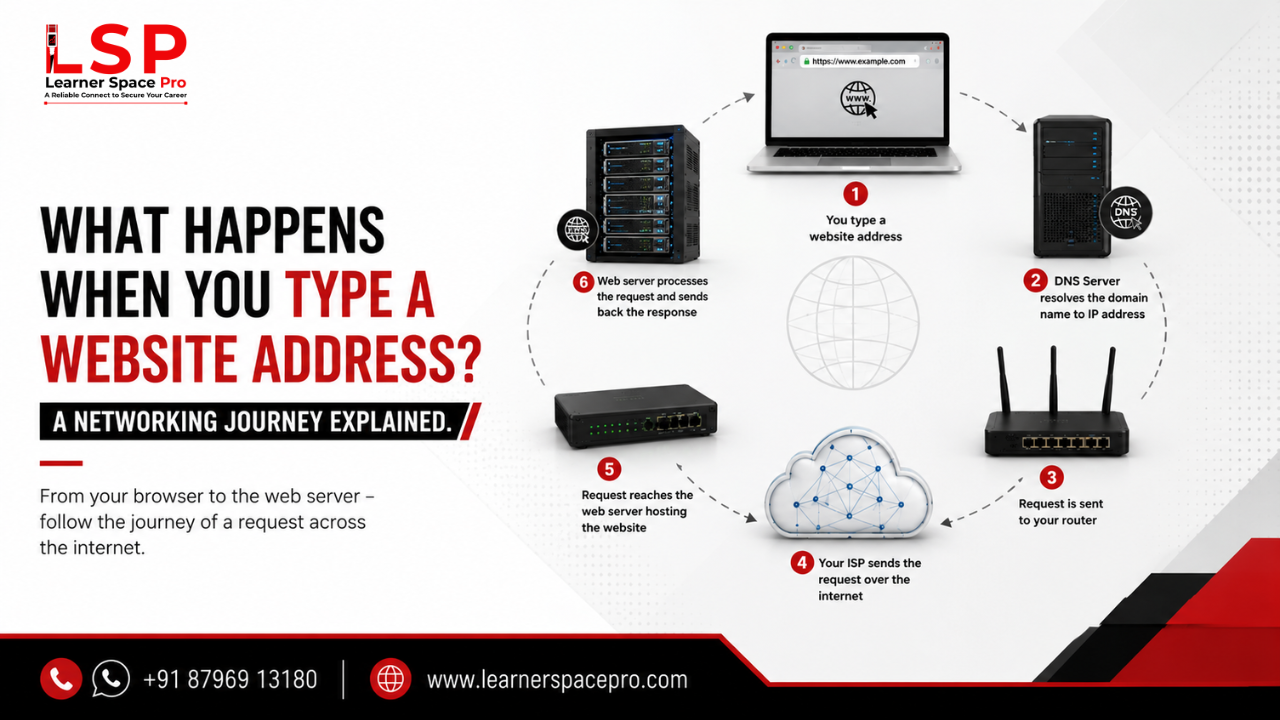
Every day, billions of people open a web browser, type a website address, and instantly access information. It feels almost effortless, but behind those few seconds lies a fascinating networking process involving DNS servers, routers, switches, internet service providers, and web servers working together.
For learners preparing for CCNA Certification in India, understanding this journey is one of the best ways to connect networking concepts with real-world applications. Instead of memorizing protocols and definitions, you begin to understand how modern networks actually function.
At Learner Space Pro, we encourage learners to understand the “why” behind networking concepts because practical understanding makes both certification preparation and troubleshooting much easier.
Step 1: Your Browser Checks Its Cache
When you type a website address such as www.LearnerSpacePro.com, your browser first checks whether it has already visited the website recently.
If the IP address is stored in the browser’s cache, the browser immediately uses it without performing another DNS lookup, reducing loading time.
If no cached information exists, the browser moves to the next step.
Step 2: DNS Converts the Website Name into an IP Address
Computers do not communicate using website names, they communicate using IP addresses.
A Domain Name System (DNS) server acts like the internet’s phonebook by translating a domain name into the correct IP address.
Without DNS, users would have to remember numerical IP addresses instead of simple website names.
This is one of the most important networking concepts covered during Cisco CCNA Certification training.
Step 3: Your Device Sends the Request
Once the IP address is known, your computer prepares a data packet containing the request.
The packet includes:
- Source IP Address
- Destination IP Address
- Protocol Information
- Requested Data
Before leaving your device, the packet is forwarded to your default gateway, usually your home or office router.
Step 4: Routers Find the Best Path
The router examines the destination IP address and determines the best path for the packet to travel.
Along the journey, the packet passes through multiple routers owned by your Internet Service Provider (ISP) and other network providers before reaching the destination server.
Each router makes forwarding decisions in milliseconds using routing tables.
Step 5: The Web Server Responds
When the packet reaches the web server, the server processes the request and prepares the webpage.
The response may include:
- HTML
- CSS
- JavaScript
- Images
- Videos
- Other website resources
The server sends these files back through the internet using the same networking principles.
Step 6: Your Browser Displays the Website
As the files arrive, your browser processes the code and renders the webpage on your screen.
Within a few seconds, what began as a simple domain name becomes a fully interactive website.
Behind this process are multiple networking technologies working together seamlessly.
Why This Matters for CCNA Students
Many learners study networking concepts separately like DNS, routing, switching, TCP/IP, and IP addressing without understanding how they interact.
Following the complete journey of a website request helps connect these concepts into one practical workflow.
Instead of viewing networking as isolated topics, you will begin to see how enterprise networks operate in the real world.
Learn Networking Through Practical Understanding
The best networking professionals do not simply memorize commands; they understand why networks behave the way they do.
For learners who want to strengthen both conceptual knowledge and practical skills, a structured CCNA Training in Bengaluru program can provide guided labs, real-world scenarios, and instructor support that transform theory into practical experience.
Build Your Networking Skills with Learner Space Pro
Preparing for CCNA Certification in India is not just about passing an exam, it is about understanding how networks power the digital world. At Learner Space Pro, our practical training approach helps learners develop this understanding through instructor-led sessions, hands-on lab exercises, and real-world networking examples. By mastering the fundamentals today, you will be better prepared for a successful career in networking, cloud computing, and cybersecurity.