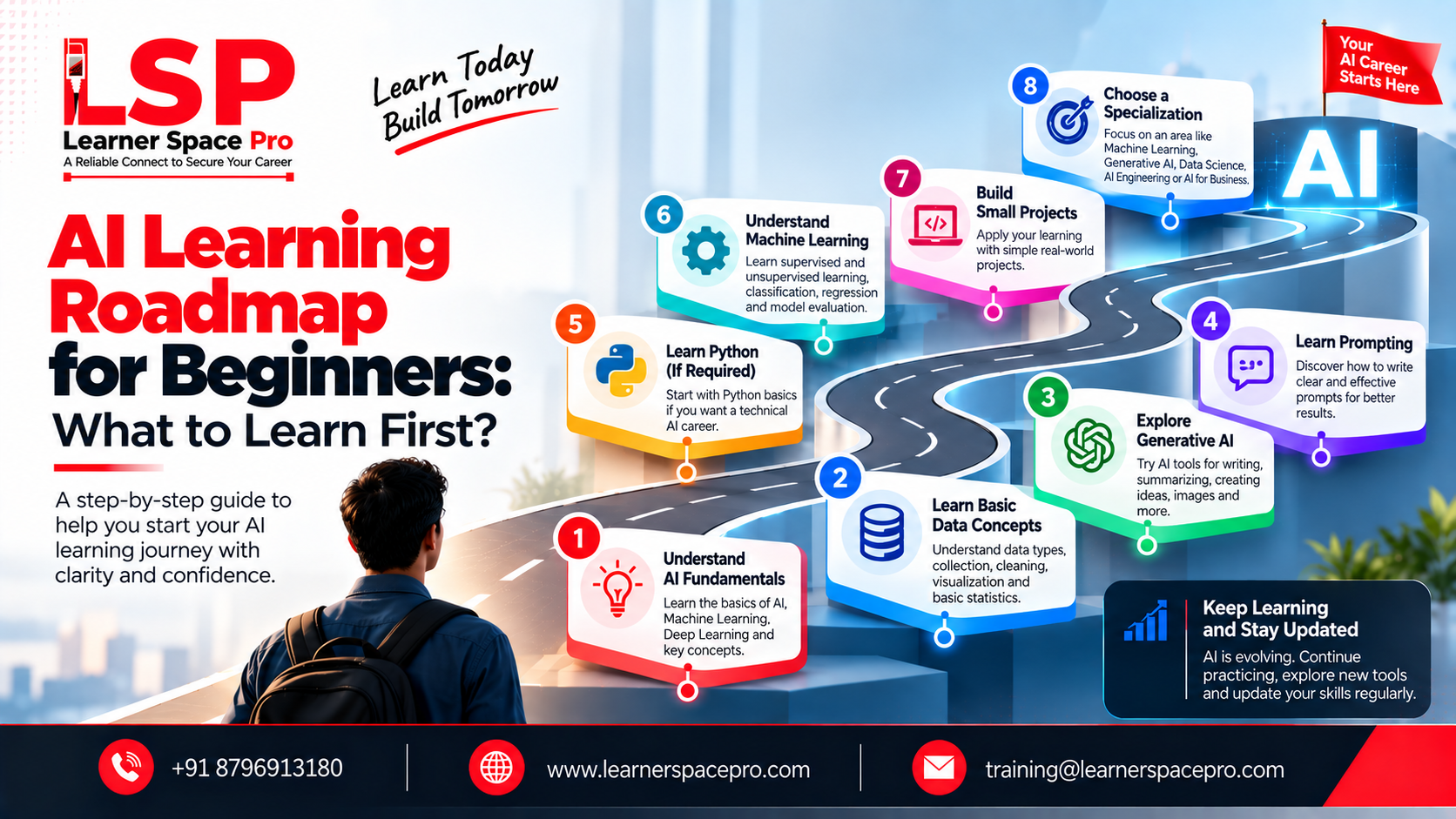
Artificial Intelligence can look overwhelming when you are just getting started. There are so many areas to explore: Machine Learning, Generative AI, data, Python, automation, and more. A clear AI Learning Roadmap can make the process much easier by showing you what to learn first and what you can study later.
At Learner Space Pro, we believe beginners learn better when they have a clear direction. Instead of trying to learn every AI technology at once, it is better to build your knowledge step by step and practice along the way.
Step 1: Understand AI Fundamentals
Start by understanding what Artificial Intelligence actually means.
Learn the basic ideas behind:
- Artificial Intelligence
- Machine Learning
- Deep Learning
- Generative AI
- Natural Language Processing
- Computer Vision
You do not need to understand the technical details immediately. Your first goal should be to understand what each technology does and how they are connected.
Step 2: Learn Basic Data Concepts
AI systems depend heavily on data.
You do not need to become a data scientist at the beginning, but you should understand basic concepts such as:
- Types of data
- Data collection
- Data cleaning
- Patterns and trends
- Basic statistics
- Data visualization
This will help you understand where AI gets its information and why the quality of data matters.
Step 3: Explore Generative AI
Once you understand the basics, start experimenting with Generative AI.
Try using AI tools for everyday tasks such as:
- Writing
- Summarizing information
- Research
- Creating ideas
- Generating images
- Creating simple content
- Supporting coding
This gives you practical experience and helps you understand both the strengths and limitations of AI.
Step 4: Learn Prompting
Knowing how to communicate with AI tools is becoming a useful skill.
Learn how to create clear prompts by including:
- A specific task
- Relevant context
- Your target audience
- The desired format
- Any important limitations
Do not worry about creating complicated prompts. Clear instructions are often more useful than long instructions.
Step 5: Learn Python If You Want a Technical Career
If your goal is to move toward machine learning or AI development, Python is an important skill to add to your roadmap.
Start with the basics:
- Variables
- Conditions
- Loops
- Functions
- Lists and dictionaries.
- Basic file handling
Once you are comfortable, you can move into libraries used for data analysis and machine learning.
If you do not want a technical AI role, you may not need to go deeply into programming.
Step 6: Understand Machine Learning
After building your foundation, you can start learning how machines learn from data.
Some beginner topics include:
- Supervised learning
- Unsupervised learning
- Classification
- Regression
- Training and testing
- Model evaluation
At this stage, practical examples are much more useful than simply memorizing definitions.
Step 7: Build Small Projects
This is where your learning starts becoming practical.
You could build simple projects such as:
- A basic chatbot
- A recommendation system
- A prediction model
- A document summarizer
- A simple AI-powered application
Your projects do not need to be complicated. The goal is to understand how the concepts you have learned can solve real problems.
Step 8: Choose a Specialization
Once you have explored the basics, you can decide which direction interests you most.
Possible paths include:
Machine Learning
For people interested in data and predictive models.
Generative AI
For those interested in modern AI applications, content generation, and AI-powered workflows.
Data Science
For people who enjoy working with data, statistics, and business insights.
AI Engineering
For learners interested in building and deploying AI applications.
AI for Business
For professionals who want to use AI for productivity, automation, and decision-making.
How Long Does the AI Learning Journey Take?
There is not one fixed timeline.
You can learn the fundamentals in a few weeks with consistent study. Building technical skills and completing projects will take longer.
Instead of focusing only on how quickly you can finish, focus on whether you can actually explain and apply what you have learned.
Even 30–60 minutes of regular practice can make a difference when you stay consistent.
Keep Learning as AI Changes
AI is developing quickly, so learning should not stop after completing one course.
New tools and applications appear regularly. Continue experimenting, follow developments in the industry, and update your skills as the technology changes.
The goal is to build a strong foundation that allows you to keep learning.
Start Your AI Journey with Learner Space Pro
A good AI Learning Roadmap does not require you to learn everything at once. Start with the fundamentals, experiment with AI tools, develop practical skills, and then choose a specialization that matches your interests and career goals.
At Learner Space Pro, our AI programs are designed to help learners move from basic concepts toward practical applications through structured learning and real-world examples. Whether you are starting from scratch or adding AI to your existing skill set, having a clear learning path can make the journey more focused and manageable.