Cyberattacks are becoming more complex, and security teams have to deal with huge amounts of data every day. This is one reason AI in Cybersecurity is becoming increasingly important. AI can help security teams identify unusual activity, analyze information faster, and respond to potential threats.
At Learner Space Pro, we help learners understand how modern technologies are changing IT and cybersecurity. Learning how AI can support security teams is becoming useful for both cybersecurity professionals and people who are planning to enter the field.
Why Is AI in Cybersecurity Useful?
A traditional security team may have to examine thousands of alerts, log entries, network events, and user activities.
Doing all of this manually can take a lot of time.
AI can process large amounts of information quickly and help security teams identify patterns that might otherwise be difficult to notice.
For example, an AI-powered system could notice that a user is suddenly logging in from unusual locations or accessing resources they normally do not use.
This does not automatically mean there is an attack, but it can give the security team something worth investigating.
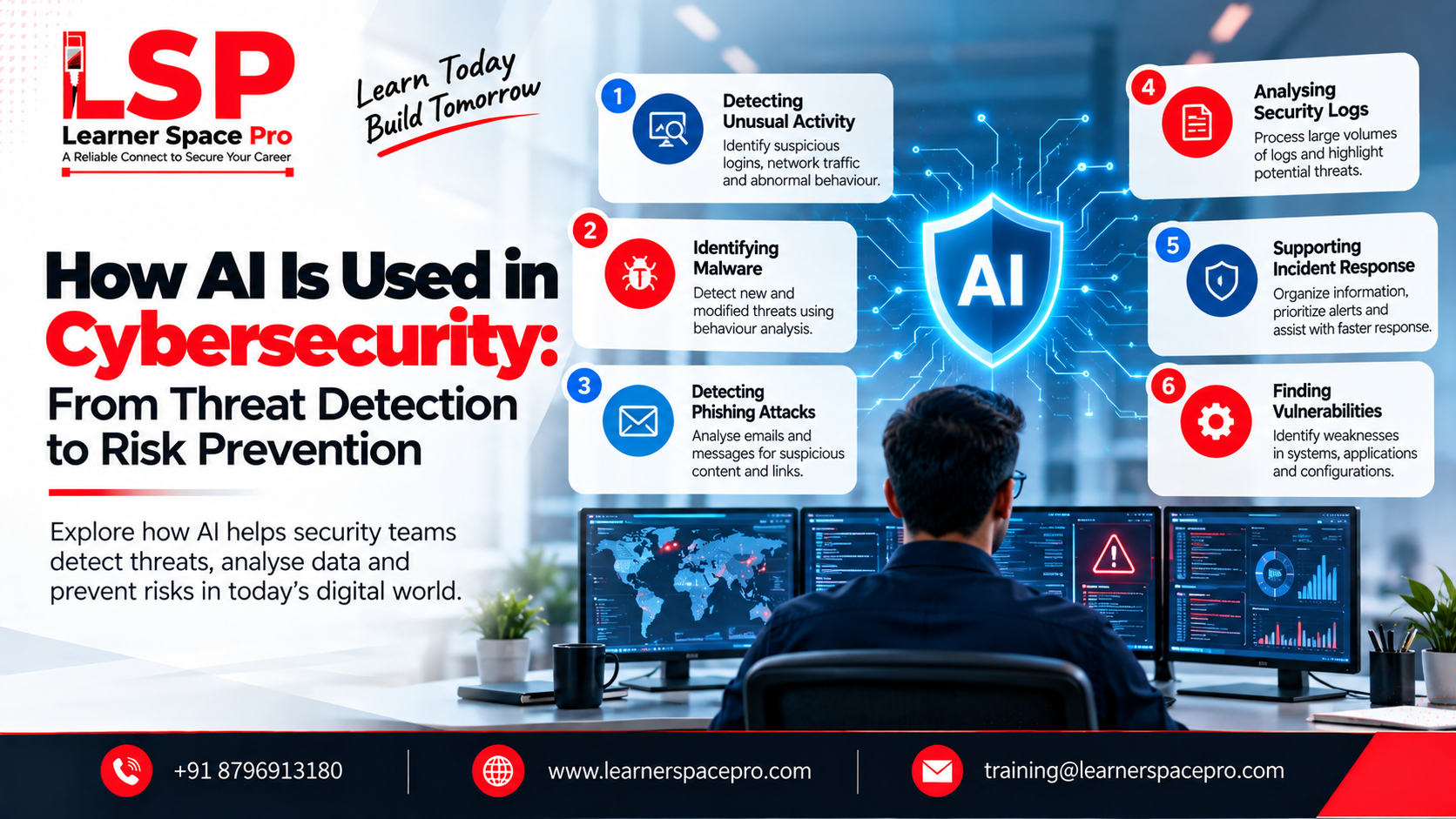
1. Detecting Unusual Activity
One of the common uses of AI is identifying activity that does not match normal behaviour.
AI systems can learn what normal activity looks like and flag significant changes.
Examples include:
- Unusual login attempts
- Unexpected network traffic
- Large data transfers
- Abnormal account activity
- Repeated failed logins.
Security Frofessionals can then investigate these alerts and determine whether there is a genuine threat.
2. Identifying Malware
AI can also support malware detection.
Traditional security tools often depend on known patterns or signatures. AI-based systems can look for suspicious characteristics and behaviour that may indicate malicious software.
This can be particularly useful when security teams encounter new or modified threats.
However, AI is not perfect. Security teams still need other detection methods and human analysis.
3. Detecting Phishing Attacks
Phishing remains a common security problem.
AI can analyse emails and messages for signs of suspicious behaviour, such as unusual language, links, attachments, or sender patterns.
Organizations can use these capabilities to help identify potentially dangerous messages before employees interact with them.
4. Analyzing Security Logs
Modern organizations generate enormous amounts of security information.
Instead of manually reviewing every event, AI can help analyze logs and highlight activity that may deserve attention.
This can reduce the amount of time security analysts spend searching through large datasets.
5.Supporting Incident Response
When a security incident happens, speed matters.
AI can help security teams organize information about an incident, identify related events, and prioritize alerts.
It can also assist with repetitive tasks, allowing security professionals to spend more time investigating the actual problem.
AI should support the response process rather than make important security decisions without human oversight.
6. Finding Vulnerabilities
AI can also assist organizations in identifying weaknesses in systems and applications.
It can help analyze code, configurations, and other information to identify areas that may require further security testing.
Security professionals can then validate the findings and decide how the vulnerabilities should be addressed.
Can AI Replace Cybersecurity Professionals?
No.
AI can process information quickly, but cybersecurity still requires human judgment.
Security professionals need to understand the business environment, investigate suspicious activity, make decisions, communicate risks, and respond to incidents.
AI is better viewed as an additional tool that helps security teams work more efficiently.
What Are the Risks of Using AI for Security?
AI itself can introduce new challenges.
Organizations need to consider:
- False alerts
- Incorrect results
- Data privacy
- Model bias
- Security of AI systems
- Lack of human oversight
An AI system can make mistakes, so important security decisions should not depend entirely on automated output.
What Should Cybersecurity Professionals Learn?
Cybersecurity professionals do not necessarily need to become AI researchers.
However, understanding basic AI concepts, security automation, data analysis, and AI-powered security tools can be useful.
Learning how AI systems work can also help security professionals better understand the risks that come with AI adoption.
Build Modern Cybersecurity Skills with Learner Space Pro
AI in Cybersecurity is changing how organizations approach threat detection, monitoring, and security operations. But technology alone is not enough. Skilled professionals are still needed to understand threats and make informed decisions.
At Learner Space Pro, our cybersecurity and AI learning programs help learners connect technical concepts with practical applications. Developing knowledge across both areas can help students and professionals prepare for a technology landscape where Artificial Intelligence and cybersecurity increasingly work together.