If you have started learning networking, you have probably come across subnetting in computer networks. For many beginners, subnetting can seem difficult because it involves IP addresses, subnet masks, and binary calculations. However, once you understand the logic behind it, subnetting becomes one of the most useful networking skills you can develop.
Whether you are preparing for a CCNA course or planning a career in networking, understanding how networks are divided and organized will help you work with real-world infrastructure more confidently. At Learner Space Pro, we help learners understand networking concepts through practical examples and hands-on lab exercises rather than relying only on memorization.
What Is Subnetting?
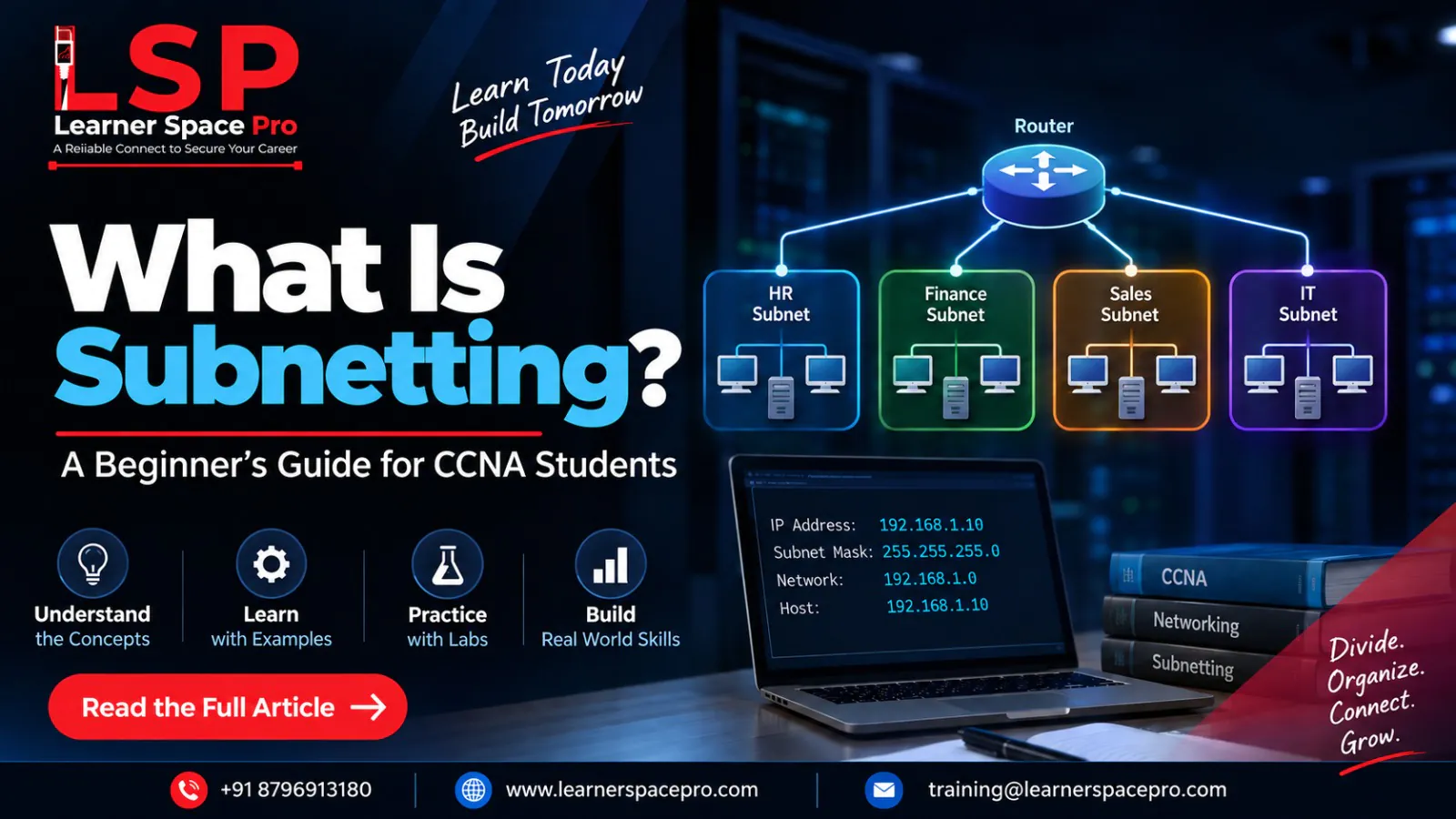
In simple terms, subnetting is the process of dividing a larger network into smaller networks called subnets.
Instead of placing every device within one large network, organizations can divide their infrastructure into smaller sections. As a result, networks becomes easier to manage, improves traffic efficiency, and provides better control over communication.
For example, a company could create separate subnets for:
- Human Resources
- Finance
- Sales
- IT
- Guest Wi-Fi
Each department can have its own network segment while still being part of the organization’s overall infrastructure.
Why Is Subnetting Important?
As an organization grows, so does the number of computers, servers, phones, and other connected devices. Managing all these devices within one large network can create unnecessary traffic and make troubleshooting more complicated.
Subnetting helps network administrators:
- Use IP addresses efficiently.
- Reduce unnecessary broadcast traffic.
- Organize devices into logical networks.
- Improve network performance.
- Simplify network management.
- Support better network segmentation.
- This is why subnetting is considered an important part of networking fundamentals.
Understanding IP Addresses and Subnet Masks
To understand subnetting, you first need to understand how an IP address works.
An IPv4 address contains 32 bits and is divided into a network portion and a host portion. The subnet mask determines which part identifies the network and which part identifies individual devices.
For example:
IP Address: 192.168.1.10
Subnet Mask: 255.255.255.0
Here, the subnet mask helps identify which devices belong to the same network.
By changing the subnet mask, network administrators can create multiple smaller networks from a larger address range.
Where Is Subnetting Used?
Subnetting is widely used across modern IT environments.
You can find it in:
- Corporate networks
- Data centers
- Educational institutions
- Banking infrastructure
- Healthcare organizations
- Cloud environments
- Government networks
For example, an organization with offices in different locations can allocate different IP ranges to each office. This makes network management and troubleshooting much easier.
Why Should CCNA Students Learn Subnetting?
Subnetting is an important networking skill for anyone pursuing a CCNA Course. It supports several areas of networking, including IP addressing, routing, network design, and troubleshooting.
More importantly, subnetting is not simply an exam topic. Network professionals use IP addressing and subnetting when designing networks, allocating addresses, configuring devices, and resolving connectivity problems.
Understanding the reasoning behind subnetting is therefore much more valuable than simply memorizing calculation shortcuts.
How to Learn Subnetting More Easily
Many beginners struggle because they immediately jump into complex calculations. A better approach is to build your understanding gradually.
Start by learning:
- Binary numbers and their relationship to IP addresses.
- IPv4 address structure.
- Subnet masks and CIDR notation.
- Network and host portions.
- Number of available subnets and hosts.
- Practical subnetting examples.
Once you understanding these concepts, practice regularly with different IP addresses and network scenarios.
Networking simulators can also help you connect it concepts with real network configurations.
Turn Theory Into Practical Networking Skills
Knowing how subnetting works is important, but applying it is what builds confidence. Creating network topologies, assigning IP addresses, configuring devices, and troubleshooting connectivity problems can help turn theoretical knowledge into practical skills.
For learners who want structured guidance and hands-on networking practice, CCNA Training in Bengaluru can provide instructor-led learning, practical labs, and real-world scenarios that complement self-study.
Build Strong Networking Fundamentals with Learner Space Pro
Subnetting is more than a calculation exercise. It is a fundamental networking skill that helps professionals design organized, efficient, and scalable networks.
At Learner Space Pro, our practical training approach helps learners develop networking fundamentals through expert guidance, hands-on labs, and real-world scenarios. Whether you are beginning your networking journey or preparing for a professional certification, building a strong understanding of subnetting in computer networks can give you a valuable foundation for future roles in networking, cloud computing, and cybersecurity.